
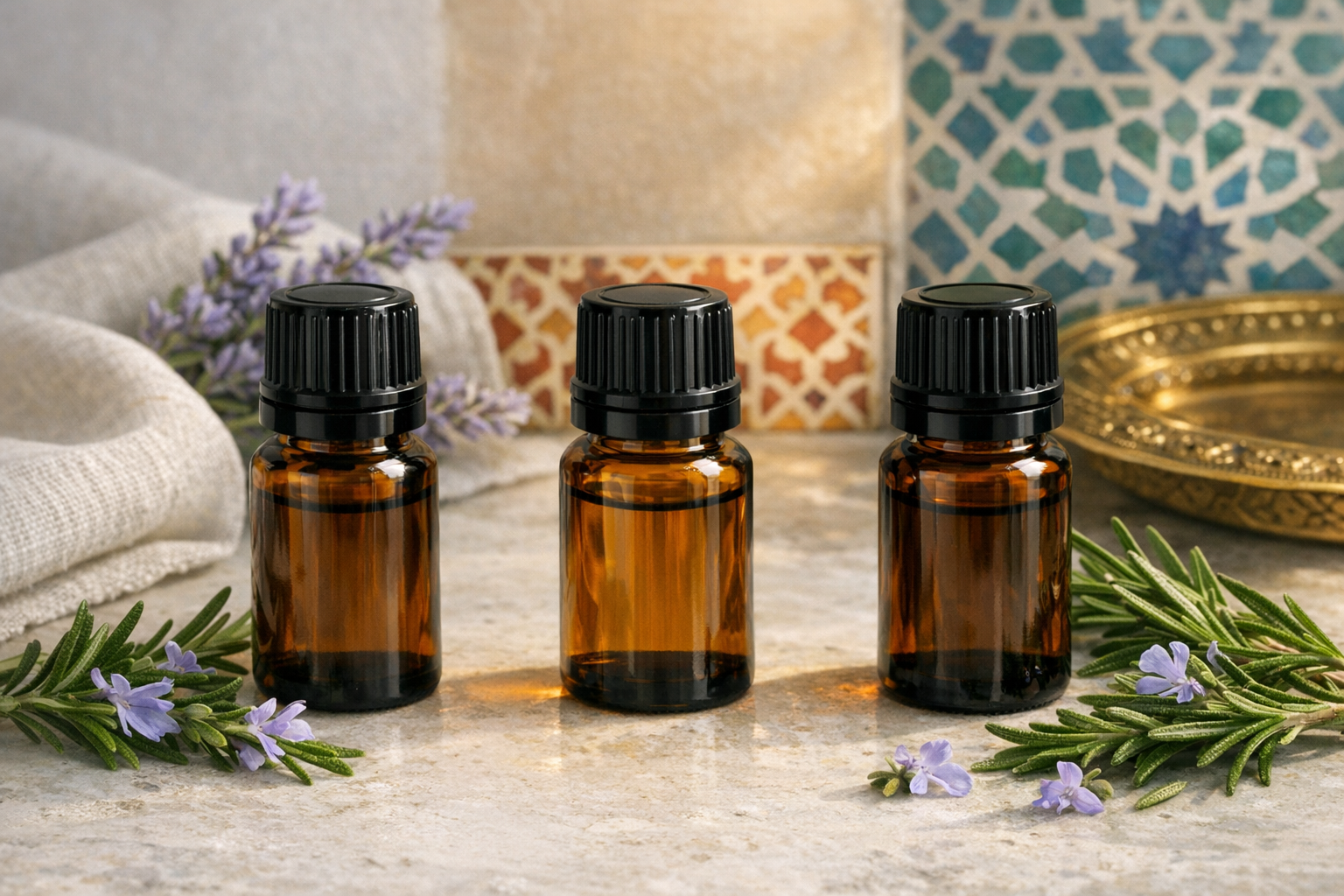
Rosemary oil seems simple until you realise there is more than one type. You might pick up a bottle expecting the same crisp, herbal aroma every time, only to find that French, Spanish and Moroccan Rosemary Oils can smell, feel and perform quite differently.
That difference usually comes down to chemotype. In plain terms, a chemotype is the natural chemical profile of a plant oil. Climate, soil, harvest timing and growing region can all influence which aromatic compounds are most prominent. With Rosemary Essential Oil, this often means one bottle may lean more towards fresh, eucalyptus-like notes, while another may feel sharper, warmer or more camphoraceous.
This guide breaks down the key differences between French, Spanish and Moroccan Rosemary Oil so you can choose the one that best suits your aromatherapy, massage, haircare or formulation goals.
Table Of Contents
- What Makes Rosemary Oils Different?
- French, Spanish And Moroccan Rosemary Oil At A Glance
- French Rosemary Oil: Best For A Softer Herbal Profile
- Moroccan Rosemary Oil: Best For Freshness And Haircare Blends
- Spanish Rosemary Oil: Best For Massage And A Warming Feel
- How To Choose The Right Rosemary Oil
- Safety Tips Before Using Rosemary Oil
- Choosing With Confidence
What Makes Rosemary Oils Different?
Rosemary Essential Oil is typically steam distilled from the leaves, stems and flowering tops of Rosmarinus officinalis, also known botanically as Salvia rosmarinus. While the plant may be the same species, the oil’s final profile can change depending on where it is grown.
The main compounds often discussed in Rosemary Oil include:
- 1,8-cineole, also known as eucalyptol.
- Camphor.
- α-pinene.
- Verbenone.
- Borneol.
- Camphene.
Research notes that Rosemary Essential Oil can vary widely in composition, with major constituents often including 1,8-cineole, α-pinene, verbenone, camphor and borneol.
Think of it like wine. A grape grown in France, Spain and Morocco will not taste identical because the growing conditions shape the final result. Rosemary Oil works in a similar way.
French, Spanish And Moroccan Rosemary Oil At A Glance
| Rosemary Oil Type | Common Profile | Aroma Feel | Often Chosen For |
| French Rosemary Oil | Often associated with softer herbal or verbenone-style profiles, depending on the source. | Herbal, fresh, slightly sweet or rounded. | Skincare-style blends, gentle aromatic use, balanced formulations. |
| Moroccan Rosemary Oil | Commonly associated with 1,8-cineole-rich profiles. | Fresh, herbal, eucalyptus-like, clean. | Haircare blends, diffuser blends, refreshing aromatic formulas. |
| Spanish Rosemary Oil | Commonly associated with camphor-rich profiles. | Strong, herbal, camphoraceous, warming. | Massage oils, muscle-focused blends, invigorating formulations. |
French Rosemary Oil: Best For A Softer Herbal Profile
French Rosemary Oil is often chosen when you want a rosemary note that feels herbal and refined rather than overly sharp. Depending on the supplier and growing region, French Rosemary may be associated with a more balanced or verbenone-style profile.
This can make it useful when you want rosemary’s recognisable freshness without making the blend feel too medicinal.
French Rosemary Oil may suit:
- Facial or body care formulations where you want a cleaner herbal note.
- Aromatherapy blends designed to feel fresh but not too intense.
- Botanical perfumes where rosemary needs to sit beside Lavender, Clary Sage, Frankincense or citrus oils.
- Diffuser blends where you want a bright, garden-like aroma.
It is not always the strongest option for a bold massage blend or a very fresh eucalyptus-style diffuser blend. Its appeal is often in its balance.
Moroccan Rosemary Oil: Best For Freshness And Haircare Blends
Moroccan Rosemary Oil is commonly connected with the cineole chemotype, meaning it tends to be naturally rich in 1,8-cineole. This gives it a fresh, clean, slightly eucalyptus-like character.
If your goal is to create a crisp diffuser blend, scalp oil, shampoo booster or refreshing body care formula, moroccan rosemary essential oil is often a strong choice. AWO describes its Moroccan Rosemary Oil as the cineol chemotype, with key constituents including 1,8-cineole, α-pinene, camphor, β-pinene and camphene.
Moroccan Rosemary Oil may suit:
- Haircare blends for scalp massage.
- Shampoo or conditioner formulations.
- Fresh diffuser blends for workspaces or study areas.
- Cleaning blends where you want a herbal, crisp aroma.
- Massage blends where you want rosemary freshness without choosing the most camphor-heavy option.
It pairs especially well with:
- Peppermint.
- Cedarwood.
- Lavender.
- Lemon.
- Basil.
- Eucalyptus.
- Pine.
A simple scalp massage blend might include Rosemary, Cedarwood and Lavender diluted into a carrier oil such as Jojoba or Fractionated Coconut Oil. Keep the dilution low, especially if applying regularly.
Spanish Rosemary Oil: Best For Massage And A Warming Feel
Spanish Rosemary Oil is commonly associated with the camphor chemotype. This makes it feel stronger, sharper and warmer than many cineole-rich rosemary oils.
If you are formulating a massage oil for tired legs, post-gym body care or a warming bath blend, spanish rosemary oil is often the more fitting option. AWO notes that its Spanish Rosemary Oil is the camphor chemotype and lists key constituents including α-pinene, camphor, 1,8-cineole, camphene and β-pinene.
Spanish Rosemary Oil may suit:
- Massage blends.
- Sports-style body oils.
- Warming foot soaks.
- Invigorating diffuser blends.
- Formulations where you want a bold herbal aroma.
Its aroma can be more assertive, so it is best used thoughtfully. A little can go a long way, particularly in blends with other strong oils like Peppermint, Eucalyptus, Black Pepper or Ginger.
How To Choose The Right Rosemary Oil
The best Rosemary Oil depends on what you want it to do in your blend.
Choose French Rosemary Oil if:
- You want a softer herbal note.
- You are making a more delicate skincare or perfume-style blend.
- You want rosemary to support the aroma without dominating it.
- You prefer a rounded, less camphor-heavy scent.
Choose Moroccan Rosemary Oil if:
- You want a fresh, clean and uplifting aroma.
- You are making haircare or scalp care blends.
- You want a rosemary oil that pairs well with citrus, mint and woods.
- You like eucalyptus-style freshness.
Choose Spanish Rosemary Oil if:
- You want a stronger, warmer rosemary profile.
- You are making massage oils or body blends.
- You want a bold camphoraceous scent.
- You are blending with other robust oils.
Best Uses By Blend Type
| Blend Goal | Best Match | Why It Works |
| Scalp oil or haircare blend | Moroccan Rosemary Oil | Its cineole-rich freshness works well in clean, herbal haircare formulas. |
| Sports massage blend | Spanish Rosemary Oil | Its camphoraceous profile gives a warmer, more intense aromatic feel. |
| Gentle botanical body oil | French Rosemary Oil | Its softer herbal profile can feel more balanced in cosmetic blends. |
| Focus diffuser blend | Moroccan or French Rosemary Oil | Moroccan feels crisp and bright; French can feel softer and less intense. |
| Strong herbal cleaning blend | Moroccan or Spanish Rosemary Oil | Both offer a fresh, powerful rosemary note. |
| Perfume-style natural blend | French Rosemary Oil | It can sit more gently beside florals, resins and citrus oils. |
Safety Tips Before Using Rosemary Oil
Rosemary Essential Oil is potent, so it should be used with care. This is especially important if you are using it on the skin, around children, during pregnancy, around pets or in a professional formulation.
Keep these tips in mind:
- Always dilute Rosemary Oil before topical use.
- Avoid applying it directly to broken or irritated skin.
- Use lower dilutions for facial products.
- Keep essential oils away from eyes and mucous membranes.
- Store bottles away from children and pets.
- Do not ingest essential oils unless guided by a qualified professional.
- Patch test new blends before wider use.
For general safety, AWO recommends topical dilution for Rosemary Oil and notes that essential oils are concentrated and may irritate the skin if used undiluted. The Tisserand Institute also discusses Rosemary Oil research in the context of haircare, including the importance of proper topical use rather than applying essential oils neat.
Choosing With Confidence
French, Spanish and Moroccan Rosemary Oils are not “better” or “worse” than each other. They are simply suited to different uses.
French Rosemary Oil is a good fit when you want a softer, more balanced herbal profile. Moroccan Rosemary Oil is ideal when you want fresh, clean, cineole-rich brightness for haircare, diffuser blends or crisp formulations. Spanish Rosemary Oil is the stronger, warmer choice for massage and body care blends where a camphoraceous aroma makes sense.
The easiest way to choose is to start with your end use. If it is for haircare, lean Moroccan. If it is for massage, consider Spanish. If it is for a more rounded aromatic or skincare-style blend, French may be the better match.